
 Bryn Purdy
Local youth was incurring the age-old ire of its despairing elders in our small Derbyshire town. The smokers, drug-takers and truants were making the Memorial Gardens unsightly with their droppings, and unsavoury to passersby at all hours of the day and into late evening by their language.
Why, oh why, one Town Councillor bemoaned, could not the youth of today behave respectably like those of yesteryear? His opinion was recorded in the local newspaper.
This question preoccupied the mind of one local young mother of three. Andrea wanted a practical answer to this rhetorical question.
The War Memorial Gardens
Why would normal healthy intelligent young people want to waste their time and risk their health in the exposed, cold and windy Memorial Gardens? Had they no homes to go to? Hadn't they got anywhere to go? Had no one asked the young people themselves? How to get an honest answer?
Andrea decided upon a strategy.
During the late-summer of 1999, she brought a packet of cigarettes (an appropriate memorial itself in these Gardens for the First World War padre, 'Woodbine Willie'), and approached the bunch of young people sitting on the four steps of the Cross.
But before she could get an answer to her question, she had to answer theirs. What did she want? Who was she? Was she a social worker? ‘I’m a nobody,’ she replied, offering her fags round. (A reply not dissimilar to another First World War padre, who announced himself on his visits to the edgy soldiers in the trenches, ‘It's only me.’ Andrea knew of neither padre until I mentioned them to her recently. There was, therefore, nothing consciously 'memorial' or derivative about either her strategy or her words.)
A Truce
It transpired that the Town Councillor's question should not have been 'Why, oh, why?' but simply 'Where?'
The 'Nobody' scurried from the insalubrious trenches occupied by the 'Poor Bloody Infantry' to the High Command of the Town Council, and back and forth between the 'drop-outs' and the 'brass hats', seeking to effect a truce between the two alien parties.
What did 'The Young Contemptibles' want?
A dry billet, a latrine, 'baccy' and an occasional drink, they replied.
If Andrea had approached the local disaffiliates in peace and conciliation, she was positively bellicose when she moved across No Child's Land, to persuade the Council to provide the 'drop-outs' with a civilised place to 'drop in'.
She was now a 'Nobody' to be reckoned with, a 'Nobody with a Cause’, in short, a Somebody who just would not go away.
How to get rid of her? Well, perhaps they should allow her to prove herself wrong. So, in February 2000, she invited local youth to meet to discuss her proposals. 83 young people attended. So close to the Millennium, her own projected title for the enterprise was ‘Project 2000', but, true to her principles, she invited the young people to propose their own title. So, as they wanted to incorporate the convivial atmosphere of a pub, The Drop Inn was opened in a set of premises donated by a local businessman.
The Drop Inn
The first I knew about Andrea's initiative was a leaflet coming through our front door in 2002, asking for support for a 'Centre for Youth, run by Youth’.
What a hope, I thought, even for Andrea, an intelligent, strong-minded young woman who had been one of the 'Befrienders' at Rowen House School some twelve years before. [Rowen House was the small residential school for the disturbed child run by Bryn Purdy and his wife Meg. ‘Befrienders’ welcomed children into their homes at tea-times and at weekends.] She had been so intelligent and sensitive to the needs of the disturbed child that I had suggested that she obtain some kind of childcare qualification.
But as for a local 'Centre for Youth Run by Youth'? What a hope!
Still, I felt must go along to offer my condolences for the lack of response to what even I must concede was a hare-brained idea.
I entered an unexpectedly crowded room in a small building, and Andrea spotted me. She immediately dodged through and around the numerous other guests to greet me.
‘So glad you could come, Bryn; you were one of the inspirations for The Drop Inn’, and she passed on her way to address the meeting.
Inspiration! Moi? Was it something I had said?
The meeting was brought to order, and it was clear that the 'Centre for Youth Run by Youth' had been up and running for the past few years, and so provenly successfully that the Town Council and the local Constabulary were subscribing to its running costs.
I sat there as Andrea recounted to those assembled how the latest drug program was developing, and how she was engaged in visiting the children and parents in their own homes.
Clearly Hare-Brained Hall was up and running, Andrea darting here, then there, meeting the needs of this or that child as he or she was flushed from the covers. But what had I said to merit being an 'inspiration'? Very gratifying, anyway. Must ask her about it some time.
In the ensuing months, I learnt how, at last, the Town Council had provided Andrea with a new, larger, rent-paid premises for the drop-outs to ‘drop in’, and Derbyshire Constabulary, already feeling the good effects about the town of the 'Centre for Youth run by Youth', was providing the wherewithal for The Drop Inn to continue.
Several months later, I found the opportunity to ask Andrea the question which had been at the back of my mind for so long.
‘You did say that I was an inspiration for The Drop Inn, didn't you, Andrea!’
‘Yes, I did’, she smiled, ‘and you were’.
‘What did. I . . . uh . . . Was it something I said? ‘
Andrea thought for a moment. ‘No’, she said, as she puzzled it out in her head, ‘nothing you said, that I can remember . . . It was more the children who came to my home for tea-times and weekends. They used to chat about what went on in school during the week. The upsets, the Moot, and their friendships . . . I learnt a lot about your school from their casual remarks . . . and it all came back to me when I opened The Drop Inn.’
‘Ah, nothing I said then. More like what the Befriendees, like Jo, and Clare and Melanie said to you.’
‘Yes, more like.’
A Few Years Later
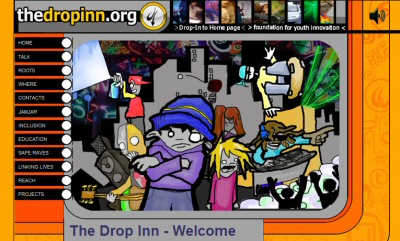 The Drop Inn had moved into a newer, larger Centre, its services expanded to include fellow-professionals, qualified and unqualified, who endorsed its logo as a Youth Centre run by Youth.
Laura Taylor was one of the original 13-year-olds who had tried to repulse the busybody on the steps of the War Memorial. At the age of 18, she was the newly appointed Secretary of The Drop Inn, and I saw her at a meeting sitting between, on her left, the local Vicar, and, on her right, the Inspector of Police responsible for the town. The brass hats and the squaddies were working together.
In 2009 she was a volunteer young manager and in January she won the Vinspired Transform Award for the East Midlands. Now in 2012 she is the general manager, and the centre has been modernised and redecorated. It has become a ‘hugely popular’ youth centre, according to the Belper News – the very paper that had once quoted the councillor who asked, ‘Why, oh why, can the youth of today not behave respectably like those of yesteryear?’