

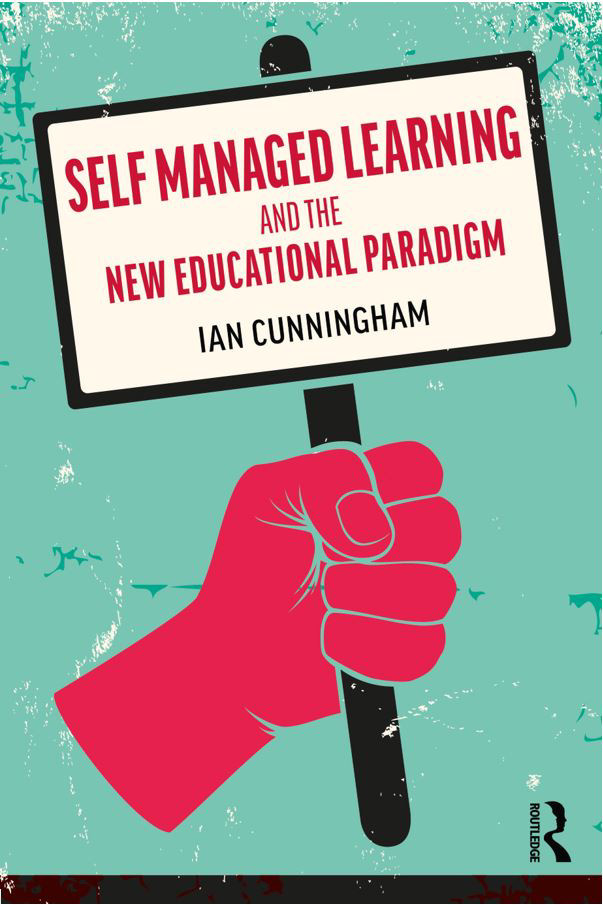
A new book by Ian Cunningham
Self Managed Learning and the New Educational Paradigm
published by Routledge, Abingdon, Oxon, UK, 2021 £16.99
Ian Cunningham’s new book offers a concise and comprehensive critique of the current education system in the UK, as well as proposing a clear and practical alternative through his descriptions of the Self Managed Learning College (SMLC) in Brighton in southern England, which caters for nine to seventeen-year-old students.
The book revisits well-trodden accounts by deschoolers and free schoolers (in the original sense) over the last century and more, confirming what we have long suspected: that education and schooling are often an impediment to learning. He uses a mixture of personal accounts alongside academic and scientific evidence to demonstrate how the current ‘Educational Paradigm’ (authoritarian and compulsory schooling, promoting quantity over quality, dependence over independence, external over internal locus of control) is deeply flawed, wasteful and often damaging to young people and wider communities. The proposed ‘New Educational Paradigm’ seeks to empower students and staff and to promote learning and experience, rather than to ‘educate’ in narrow and limiting ways.
The book gives a brief history (Chapter 4), a philosophy (Chapter 2) and a practical description of how the Self Managed Learning College operates (Chapter 8), with an emphasis on its small size (maximum 48 students), and small ‘learning groups’ (up to six students plus one, two or more staff). Students’ freedom to self-direct, to self-motivate and to ‘learn how to learn’ within a respectful and non-authoritarian environment is central. The College’s structures are robust, transparent and flexible, and everyone’s voice is heard and listened to.
At the start of their SMLC journey, students are asked to explore the Five Questions regarding who they are, where they have come from on their educational journey, where they would like to go, how they might get there, and how they will know when they have arrived. Ian Cunningham emphasises that theirs is a ‘process curriculum’ as opposed to a ‘content curriculum’, learner-based with a view to promoting autonomous individuals with a strong internal locus of control, a knowledge of the value of participation, interdependence and team- working.
The personal accounts from students past and present illustrate the success of the SMLC’s approach. However, Chapter 8 also acknowledges the struggle that some students have with ‘deschooling’ themselves, raising philosophical as well as practical questions as to the role and function of authoritarian schooling in an authoritarian society. This also raises important questions about what purpose education serves in a changing world where flexibility and creativity are essential. Proposing a ‘New Educational Paradigm’ within societies that are perhaps not ready or willing to accommodate free autonomous individuals is always going to create conflict, both internally and in wider society. However, Ian Cunningham demonstrates clearly the emotional-health and self-motivational gains from the ‘New Educational Paradigm’ for both individuals and wider society.
The book acknowledges that such ideas do not come out of a vacuum, citing (particularly in Chapter 4) influences from AS Neill to Yakov Hecht, via Roland Meighan and Jerry Mintz, IDEN, the Centre for Personalised Education, the Phoenix Trust and the Freedom to Learn Network. Hence, to propose it as a ‘New Educational Paradigm’ is possibly inaccurate (i.e. it is not that new), but the point is clear that the implementation of such ideas is long-overdue.
Overall, this is an informative, well-researched and interesting account of a practical and successful on-going education project (SMLC). The philosophical and academic background and justification is not new, although the academic research cited is mostly bang up to date and even acknowledges the influence of the Covid pandemic on home schooling and virtual learning. This is a welcome contribution to a long and hard-fought debate over what education is for, and in what practical ways it is possible to make institution-based as well as life-long learning a positive and practical experience to promote autonomy and self-reliance.
James Bar Bowen